Leaving Microsoft happens step by step, and administrations of every size have started. On 11 November 2026, the Swiss Federal Council's delegate for digital affairs set out the move of 3,000 staff to a free office suite. The European Commission is equipping more than 40,000 staff with a free instant messaging tool, and the French research centre CNRS has moved 50,000 mailboxes from Exchange to free software. None of these organisations changed everything at once: each started with one tool or one group of users.
Switzerland: 3,000 federal staff on a free suite
The Federal Chancellery tested a free office suite with 172 staff from several departments. Document editing, file storage, collaboration, email and calendars met expectations. Large video conferences showed limits. On 2 September 2026, the Federal Council drew an "in principle, yes" from the test.
From the end of 2027, about 3,000 staff will work on this suite: email, calendar, documents, telephony and video calls. They are chosen from departments with critical business processes. The first phase costs about 9 million Swiss francs, and the suite will run alongside Microsoft 365. The Confederation has about 54,000 workstations.
Daniel Markwalder, the Federal Council's delegate for digital transformation, sums up the method in an opinion piece published by Netzwoche: "Digital sovereignty is not a switch, it is a mixing desk." He adds that doing nothing is not an option. For the Chancellery, the main difficulty comes from business applications tied to the Microsoft environment.
The European Commission and France talk over Matrix
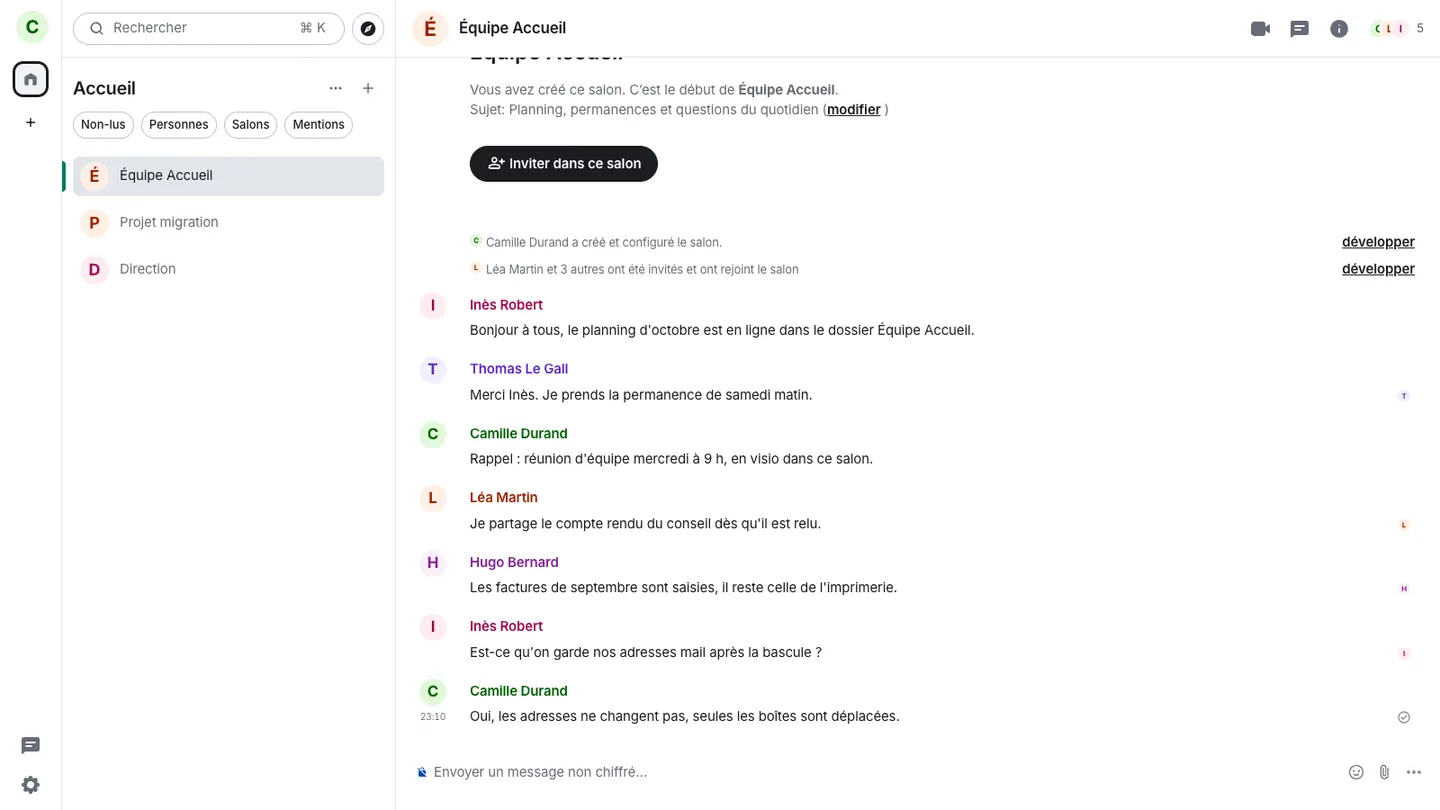
Matrix is a free instant messaging protocol. Each organisation runs its own server, and the servers talk to each other, as email servers do. According to Computerwoche, the European Commission is rolling out Element, a Matrix client, to more than 40,000 staff, with a desktop app since September 2026. In France, Tchap, the government messaging app built on Matrix, has more than 400,000 users each month.
At the Matrix 2026 conference, the Commission, the French interministerial digital directorate (DINUM), NATO, a Swedish agency and a Schleswig-Holstein administration exchanged messages live, each from its own server. According to Matthew Hodgson, co-founder of Matrix, Europe has 65 deployments at national or international level.
For a local authority or an SME, this model avoids depending on a single supplier: you keep your own server and still talk to your partners. Our comparison of Teams alternatives covers Element, Nextcloud Talk, Tchap and Visio.
The CNRS moves 50,000 mailboxes from Exchange to Zimbra
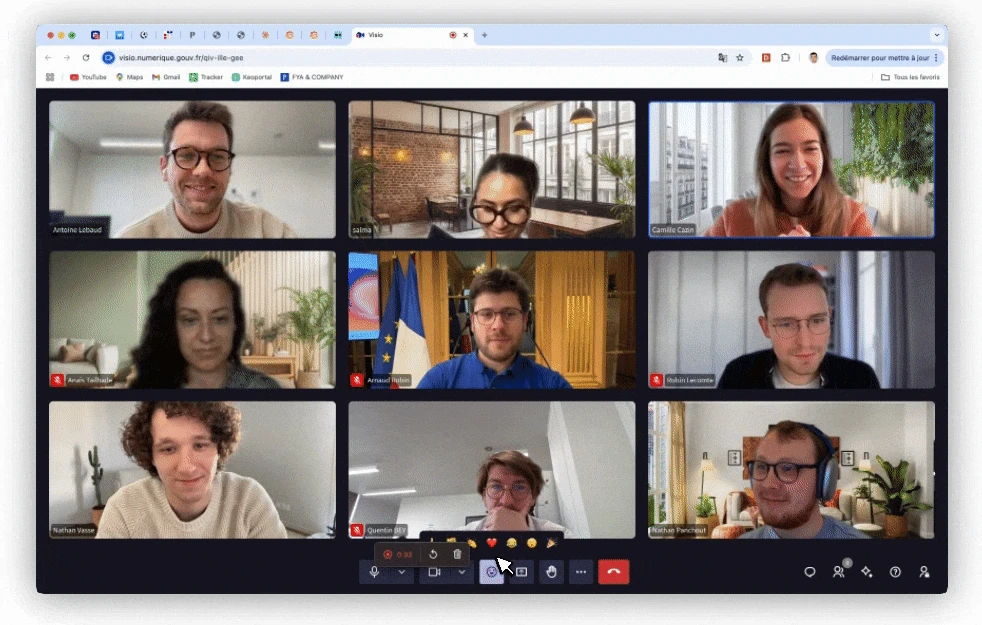
The CNRS replaced Microsoft Exchange with PARTAGE, the collaborative email service run by RENATER, the French higher education and research network. PARTAGE is built on Zimbra, a free software suite, and already serves several dozen universities. According to Solutions Numériques, about 35,000 staff and nearly 50,000 mailboxes are concerned, for savings of 3.5 million euros a year.
According to L'informatique, users mainly report slowness with large address books and difficulty bringing over fifteen-year-old Outlook archives. Both points can be prepared before the migration.
Public purchasing follows the trend
On 11 November, the MEPs in charge of the future EU Cloud and AI Development Act asked public administrations to buy more from European suppliers. According to the Commission, three non-European providers hold more than 70% of the cloud market in Europe. Dutch MEP Reinier Van Lanschot put it this way: "Europe has brilliant companies, and they are not asking for subsidies, they are asking for customers."
In Germany, VITAKO, the association of municipal IT providers, asks in a position paper reported on 9 November for digital sovereignty to become an award criterion in public tenders, and for openDesk to receive lasting funding for municipalities.
The Free Software Foundation Europe (FSFE) points out that a European supplier is not enough: the buyer must be able to understand and modify the software, share it, and choose who maintains it. Free software installed on a server in your name meets these four conditions.
Migrating step by step, like these administrations
All three examples follow the same pattern: a test with volunteers, one tool at a time, and the old system kept alongside during the switchover.
flowchart TD
  A["Audit<br/>tools, volumes, business applications"] --> B["Pilot<br/>a volunteer team, four weeks"]
  B --> C["One tool at a time<br/>video, files, email, office suite"]
  C --> D["Switchover<br/>over a weekend, latest changes copied"]
  D --> E["Operations<br/>updates and training"]
- The audit lists your tools, data volumes and business applications tied to Microsoft. For Switzerland, these applications are the main difficulty.
- The pilot lasts four weeks with a volunteer team. Like the Swiss Chancellery, you measure what works before involving everyone.
- One tool at a time. Video calls and chat are quick to test. Files then move to Nextcloud, email to a European email service, and workstations to LibreOffice or Linux.
- The switchover of each tool happens over a weekend. The latest changes are copied and checked, and the team starts Monday on the new tool.
- Operations cover security updates, the yearly major upgrade and training for users and administrators.
Hebeko supports your migration
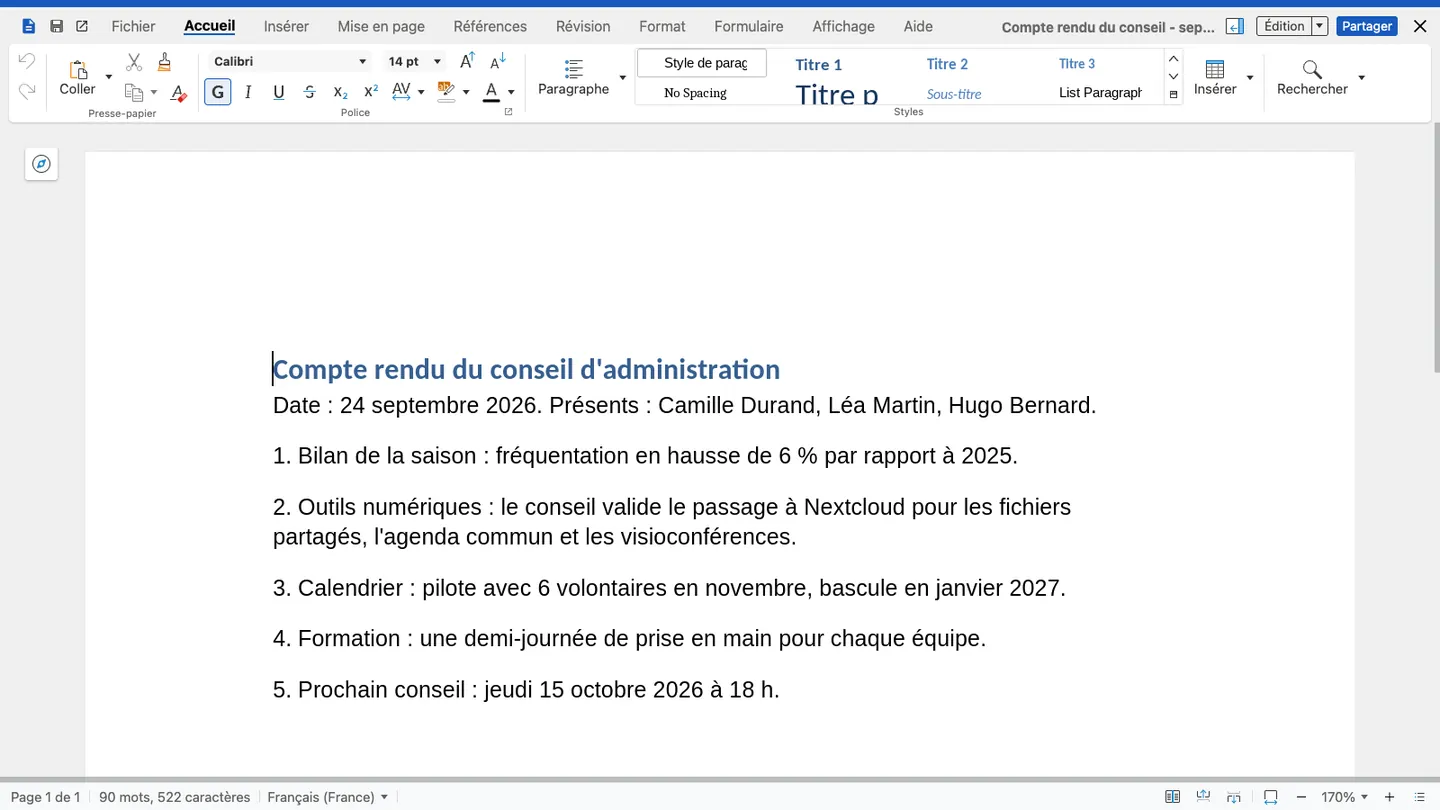
Hebeko runs these migrations for local authorities, non-profits and SMEs: audit, migration one tool at a time, hosting in France on a server in your name, maintenance and training. The hosting contract is in your name, and another provider can take over operations.
- Migrating from Microsoft 365 to free software
- Free software for the public sector
- Digital sovereignty, explained
- The cost of leaving Microsoft 365
- Migrating to Nextcloud: schools and administrations across Europe
To review your tools and choose where to start, write to us.
Sources
- Bundeskanzlei lanciert Programm für einen digital souveränen Arbeitsplatz, Swiss Federal Chancellery, 2 September 2026
- Wie die Bundesverwaltung digital souveräner wird, Daniel Markwalder, Netzwoche, 11 November 2026
- Open-Source-Alternative zu Teams gewinnt in Europas Behörden Boden, Computerwoche, 10 November 2026
- Le CNRS troque Microsoft Exchange et Zoom contre des outils souverains, Solutions Numériques
- Le CNRS abandonne Microsoft Exchange pour le logiciel libre français, L'informatique, 8 November 2026
- Le CNRS continue son ménage anti-GAFAM, sa messagerie migre vers Partage de Renater, Next
- Les eurodéputés veulent réduire la dépendance au cloud non européen, Euronews, 11 November 2026
- Souveränität braucht Spielraum, Behörden Spiegel, 9 November 2026
- Free Software first approach in EU and 2026 YH4F winners, FSFE, 11 November 2026